
How Personalization Enhances User Experience on Modern Websites

Imagine entering a preferred coffee shop and, without even stating your order, the barista greets you by name and prepares your usual drink, which feels completely normalized, adjusted, and personalized, just like an ideal user experience should feel. Similarly, In the digital world we live in, people now expect that same level of personalization in UX design from the websites they visit.
Research shows that 71% of users expect brands to deliver personalized user experiences. But, UX personalization is more than giving product recommendations. It is about creating that journey by influencing user engagement, loyalty, and revenue. Websites have long ago abandoned the one-size-fits-all concept; they have since become user-specific in creating a personalized web experience for their users, catering to the users’ unique needs.
Understanding UX Personalization
User experience personalization is fundamentally changing a website’s present content, design, and interaction to mirror a person’s behavior, tastes, and interests. While unmodified pages exist, website personalization enables content to be modified in real time to give a sense of relevance and intuitiveness with that interaction.
A good UX personalization design keeps pathways toward fulfilling user desires relatively simple. For instance, the online bookstore could remember the past purchases of its visitors and send notifications about the latest releases in the visitors’ favorite genres, thus adding to an already customized user experience.
In marketing, it is important to differentiate between customization and personalization:
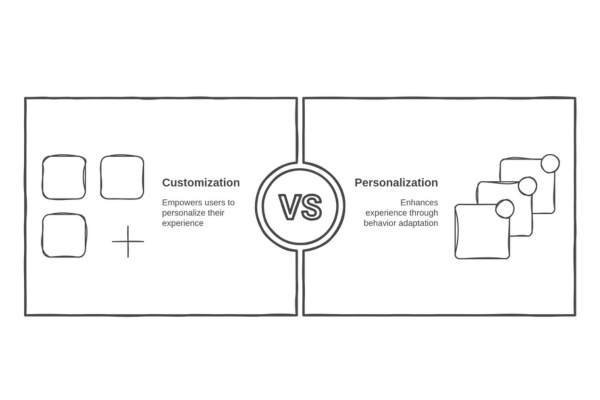
- Customization means giving control to the user so that they have the option to choose what they want to configure or set, like the theme or layout of a website.
- In comparison, personalization means the activities get automatically adjusted in correspondence with the behavior of a user, such as recommending articles to what they have read or have been interested in before.
Often, the two are included in formulating a good digital strategy. For instance, music streaming services allow users to create their playlists (customization), but they also recommend songs based on the listening habits of the user (personalization).
There are proven business benefits for brands that care about personalization and user experience. Epsilon states that 80% of consumers are more willing to buy from brands that offer them a personalized user experience. This shows just how important it is to include personalization in UX design as a key element in a digital strategy.
Site Personalization Benefits
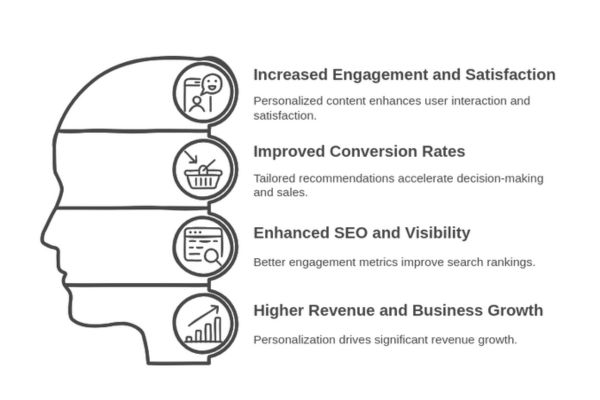
1. Increased Engagement
Well-personalized websites help stimulate more active interaction among users. When content and recommendations are personalized, users feel special and appreciated, thus interacting with the site longer.
For example, an e-commerce site saying, “Welcome back, Sarah! Here are some new arrivals in your favorite category” to a returning customer creates far more of a connection than a generic homepage. This level of website personalization is what makes the whole website experience more meaningful.
Salesforce states that 84% of customers feel that being treated as an individual contributes to their purchase decision. This means a personalized website experience isn’t a luxury; it has now become a necessity.
2. Higher Conversions
Personalization is not only about engaging the customer; it creates measurable business results. When personalized content is provided on the website, the user is more inclined to make decisions faster. With AI-enabled recommendations, browsing turns into an extremely curated path through decision-fatigue reduction and conversion-rate enhancement.
For example, an online retailer that recommends products based on a customer’s past purchases eliminates guesses and accelerates the buying process. Studies have shown that personalized product recommendations can increase conversion rates by 5.5 times, confirming that relevance has a direct effect on sales.
3. SEO & Visibility Gains
Page experience, time spent on the site, and click-through rates are significant ranking factors that can be improved with UX personalization. When a user can easily find relevant content, engagement increases, and bounce rates decrease, all positive signals that influence ranking. Users stay longer, become more interactive, as well as are to be much more willing to refer the site to others when they have found the information they want effortlessly.
These engagement signals are noted by Google’s algorithm; hence personalized sites not only promote user gratification, but also rank well in search results. A personalized user experience, therefore, isn’t just good for users; it’s a strategic advantage for SEO.
4. Revenue Growth
According to research by the Boston Consulting Group, companies that produce good user experience personalization are 40% more likely to earn revenue than competing companies. Amazon is a classic example, where the artificial AI-powered recommendations contributed to 35% of total sales.
Effective UX Personalization Strategies
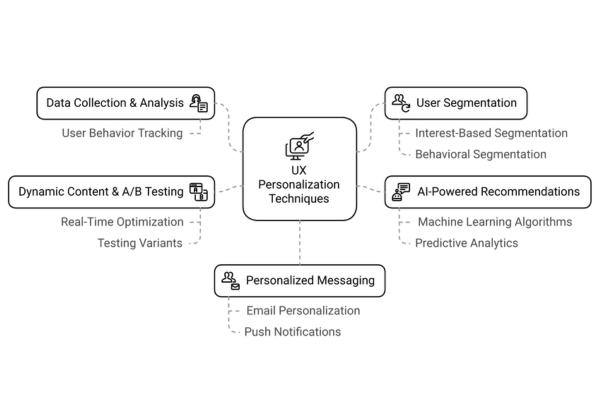
1. Data Collection
Gaining insights into user behavior is the cornerstone of personalization. Sites store information such as users’ browsing history, previous purchases, and demographics to provide personalized experiences. Transparency is also essential; users need to understand how their data is being used and maintain control over their preferences. To foster trust, compliance with data privacy laws such as GDPR and CCPA is required.
2. User Segmentation
Different users have a number of requirements. Businesses therefore need to determine their customers according to interests, behaviors, or demographics so that they can better customize content to different user types. An example would be a SaaS company grouping its users into first-time visitors, trial users, and paying customers, and presenting them with different experiences.
3. AI-Powered Recommendations
Machine learning plays a pivotal role in marketing through personalization and customization. AI would study user data and attempt to predict preferences contextually. Companies like Netflix and Spotify have implemented AI-based personalization within their businesses to gain user retention.
4. Dynamic Content & A/B Testing
Those days are long gone when static websites served their purpose. Personalization testing optimizes web pages dynamically according to the visitor’s intent. For example, an online store may show discount offers to first-time users, while for repeated buyers, it offers loyalty perks.
5. Personalized Messaging
The personalization goes beyond websites to email marketing, push notifications, and chatbots. personalized messages, such as , a discount code based on a user’s shopping habits, would generate repeat visits and customer retention.
Take Spotify’s Discover Weekly playlist. It uses AI to analyze listening behavior, duration spent on songs, skipping anthems, and the creation of playlists to give its users a unique experience. The end result is greater user satisfaction and brand loyalty.
It is extremely difficult to implement these strategies manually. Hence, the role of AI web personalization solutions comes in here. These platforms:
- Analyze the real-time behavior of users.
- Automate content adjustment based on visitor’s intent.
- Optimize personalization testing and A/B experiments.
- Integrate with the web design and marketing tools.
Thus, by leveraging such web/ux best practices, businesses can easily create smooth, extremely engaging personalized user experiences without all the hassle of manual adjustments.
Challenges & Best Practices
1. Privacy & Security
Emphasis on data makes privacy and security the top priority in any business using personalization features. Customers should be allowed to opt-out from tracking of data and give preferences on the level of personalization. Transparency creates trust and ensures that privacy issues won’t enter into a negative experience.
2. Avoiding Over-Personalization
Too much personalization in UX can create a “filter bubble” in which the user only sees content that corresponds with their past behavior and will, therefore, limit their ability to discover. So, it is all about striking the right balance between exposing new content recommendations while respecting the established user preferences.
3. Brand Consistency
The personalized website experience doesn’t belong to a separate element of the brand, it should become the extension of the brand itself. Therefore, the personalized experience should be in sync with other channel experiences, ensuring that personalization augments the user experience without disrupting it.
Conclusion
With the evolution of AI-driven web solutions, the future of website personalization will become more advanced.It is no longer an alternative for brands to personalize user interfaces UX design; it is one of the essentials. The companies that will prosper in future will be those companies that do not supply content but create real intuitive and personalized user experience for each and every visitor.
Author’s Bio:
Vidhatanand is the Founder and CEO of Fragmatic, a web personalization platform for B2B businesses. He specializes in advancing AI-driven personalization and is passionate about creating technologies that help businesses deliver meaningful digital experiences.